
Carbon-Glass Hybrid Fabric Guide (30g-240gsm)
Compare carbon-glass hybrid cloth and hybrid mat for wind energy, automotive, and industrial composites, including ratio selection and cost tradeoffs.

Carbon glass hybrid fabric — also called carbon fiberglass hybrid cloth or carbon/glass blended reinforcement — combines carbon fiber and glass fiber in one material. The goal is straightforward: capture carbon fiber’s stiffness and weight-saving benefits while using glass fiber to improve cost balance, toughness, and process flexibility.
For B2B composite buyers, hybrid reinforcement is worth considering when full carbon fiber is too costly and standard fiberglass does not provide enough performance. We manufacture two distinct hybrid product formats: woven hybrid cloth (200–240g/m²) for structural and decorative applications, and non-woven hybrid mat (30g/m²) for functional conductivity layers in wind energy and industrial composites.
Why Hybrid Reinforcement Exists
Composite design is full of trade-offs. Carbon fiber offers high stiffness and low weight, but it can be 3–5× more expensive per square meter than E-glass. Glass fiber is cost-effective and widely used, but it may not meet stiffness or weight targets for certain parts.
Hybrid reinforcement can help when a product needs:
- Better stiffness than fiberglass alone without the full cost of carbon.
- Lower cost than all-carbon reinforcement while maintaining a premium appearance.
- A distinctive technical appearance with visible carbon/glass weave contrast.
- Balanced impact tolerance — glass fiber absorbs more energy before fracture than carbon.
- Galvanic isolation in metal-contact applications where full carbon creates corrosion risk.
- Cost-effective electrical conductivity for EMI or static dissipation (hybrid mat format).
Explore both carbon fiber materials and glass fiber materials to understand the comparison.
Our Hybrid Product Range
We manufacture two distinct carbon-glass hybrid formats, each serving different applications:
Carbon-Glass Hybrid Woven Cloth (200–240g/m²)
| Specification | Details |
|---|---|
| Area weight | 200–240 g/m² |
| Carbon fiber type | T300 3K |
| Glass fiber type | E-glass |
| Weave patterns | Twill, plain |
| Standard widths | 1000mm, 1270mm |
| Primary use | Structural reinforcement + decorative visible surfaces |
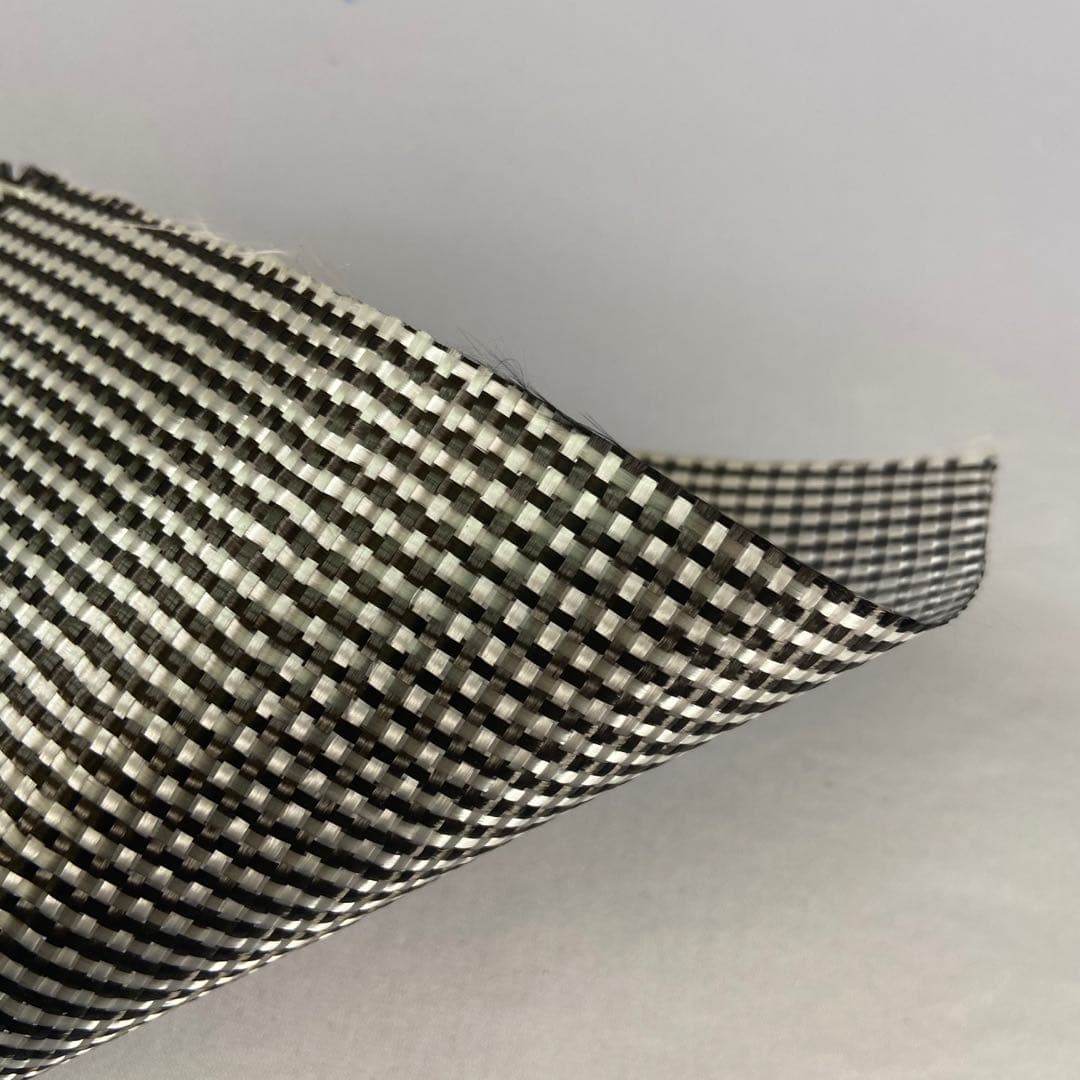
This woven hybrid cloth uses T300 carbon fiber yarns interlaced with E-glass yarns, creating a distinctive visual pattern while delivering mechanical performance between full carbon and full fiberglass. The T300 carbon provides high tensile modulus (230 GPa) while E-glass contributes impact tolerance and cost reduction.
Carbon-Glass Hybrid Mat (30g/m²)
| Specification | Details |
|---|---|
| Area weight | 30 g/m² |
| Format | Non-woven, randomly oriented short fibers |
| Primary use | Conductive functional layer, cost-effective EMI |
| Key applications | Wind energy components, industrial conductivity layers |
| Advantage | 40–60% cost reduction vs pure carbon mat at similar conductivity |
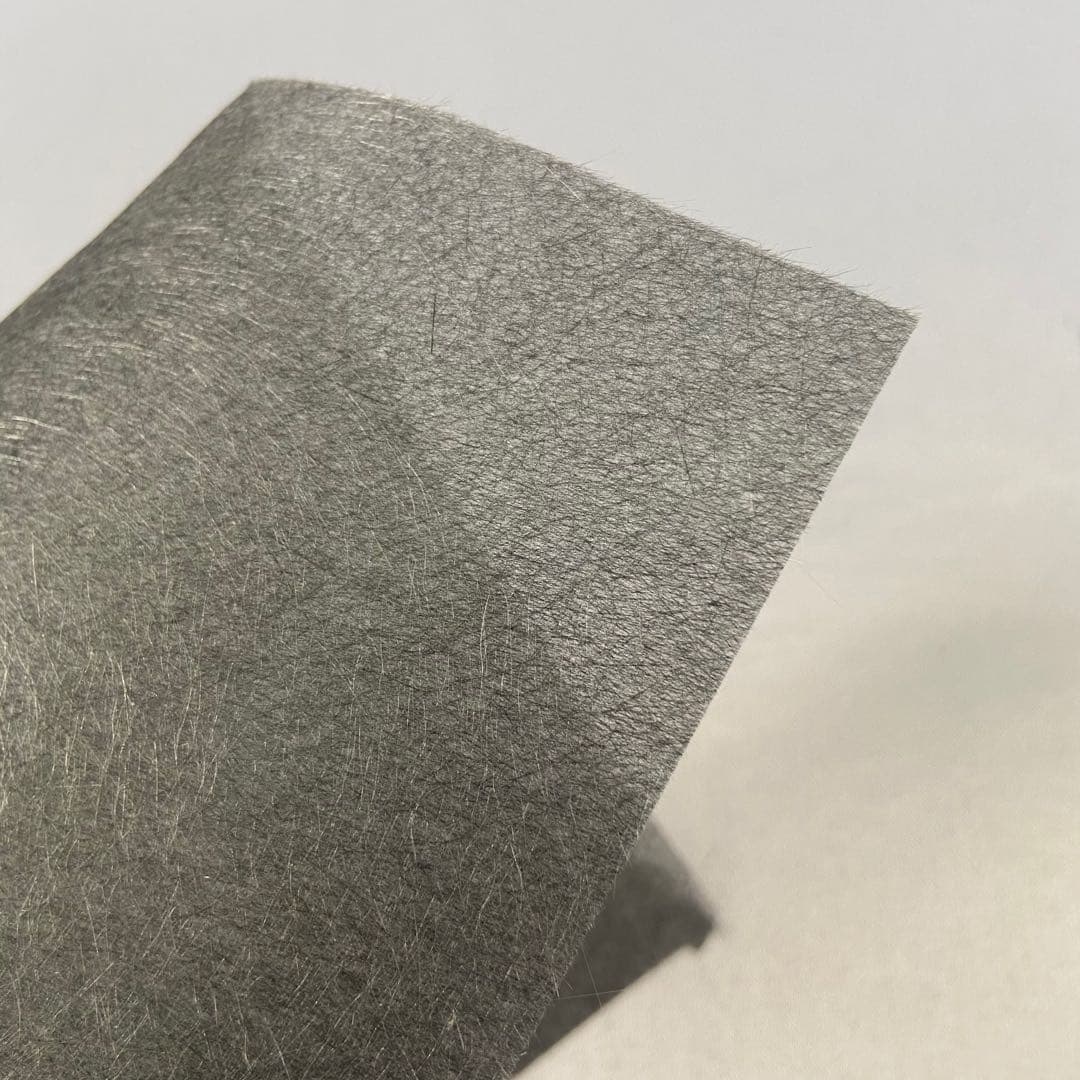
This lightweight hybrid mat blends carbon and glass fibers in a non-woven format, providing electrical conductivity at significantly lower cost than pure carbon fiber mat. It is particularly popular in wind energy applications where conductivity is needed but full carbon mat is not cost-justified.
Typical Applications
Hybrid Woven Cloth (200–240g) Applications
- Automotive and motorsport: Visible body panels, interior trim, and structural covers where the carbon/glass weave pattern adds product value.
- Sports and recreation: Bicycle frames, paddles, hockey sticks, and equipment where weight and appearance both matter.
- Consumer electronics and furniture: Decorative technical surfaces for laptop housings, speaker enclosures, and designer furniture.
- Marine: Hatches, trim panels, and interior components requiring premium appearance with cost control.
- Prototyping: Laminates where cost and stiffness must be balanced before committing to full carbon tooling.
Hybrid Mat (30g) Applications
- Wind energy: Conductive bonding layers in blade structures, lightning protection paths, and nacelle component conductivity. This is the highest-volume application for our hybrid mat.
- Industrial EMI: Cost-effective shielding layers where full carbon fiber mat is not budget-justified.
- Large composite structures: Conductivity layers in tanks, vessels, and enclosures where static dissipation is required over large surface areas.
The hybrid mat is especially valuable in wind energy because blade manufacturers need conductivity for lightning protection but cannot justify pure carbon mat across the entire blade surface area. The carbon-glass blend provides adequate conductivity at 40–60% lower material cost.
How to Specify Hybrid Fabric
When comparing hybrid fabric options, pay attention to:
| Specification | Why It Matters |
|---|---|
| Product format | Woven cloth (structural/decorative) vs non-woven mat (functional/conductive) |
| Carbon/glass ratio | Controls cost and performance balance (common ratios: 50/50, 70/30, 30/70) |
| Carbon fiber grade | T300 is standard; higher grades (T700) available for performance-critical parts |
| Weave pattern | Affects drape, appearance, and handling (twill, plain, satin) — woven cloth only |
| GSM (total area weight) | Our range: 30g (mat) and 200–240g (woven cloth) |
| Width | Impacts cutting efficiency and waste (standard: 1000mm, 1270mm, 1500mm) |
| Resin compatibility | Determines process reliability (epoxy, vinyl ester, polyester) |
| Surface requirement | Important for visible composite parts — A-side vs B-side placement |
Hybrid fabric should be tested in the actual process before large-volume purchasing. Request sample rolls (typically 10–50 linear meters) for process validation.
Hybrid Fabric vs Full Carbon vs Full Fiberglass
Full carbon fiber may be the better option when maximum stiffness-to-weight ratio is the top priority. Hybrid fabric is often better when the project needs a more balanced cost-performance profile.
A simple decision framework:
| Criteria | Full Carbon | Hybrid Cloth (200–240g) | Hybrid Mat (30g) | Full Fiberglass |
|---|---|---|---|---|
| Stiffness priority | Best | Good | N/A (functional layer) | Moderate |
| Cost sensitivity | Highest | Moderate | Low | Lowest |
| Impact tolerance | Lower | Good | N/A | Good |
| Visual appearance | Premium | Distinctive carbon/glass pattern | Not visible | Standard |
| Conductivity | Good | Moderate | Good (cost-effective) | None |
| Galvanic risk with metals | High | Reduced | Reduced | None |
| Typical weight saving vs glass | 30–40% | 15–25% | N/A | Baseline |
Decision guide:
- Choose full carbon when performance is the primary constraint and budget allows.
- Choose hybrid woven cloth when the product needs stiffness + appearance + cost control.
- Choose hybrid mat when you need conductivity at lower cost than pure carbon fiber mat.
- Choose fiberglass when cost and general reinforcement are primary.
Processing Considerations
Hybrid fabrics generally process like standard woven reinforcements, but a few points deserve attention:
- Resin wet-out: Carbon and glass fibers have different surface energies. Ensure your resin system wets both fiber types evenly — epoxy systems typically perform well.
- Thermal expansion: Carbon and glass have different CTE values. For thick laminates or high-temperature cure cycles, consider residual stress effects.
- Cutting: Use rotary cutters or automated CNC cutting. Scissors can fray hybrid edges more than single-fiber fabrics.
- Storage: Keep rolls sealed in polyethylene bags away from UV and moisture, same as standard carbon fiber.
Next Step
If the reinforcement family is still open, start with the carbon fiber versus fiberglass selection guide and compare the complete laminate and process rather than relying on a generic material ranking.
Whether you need T300 hybrid woven cloth for visible automotive panels or 30g hybrid mat for wind energy conductivity layers — we manufacture both formats. Review carbon fiber products, compare with glass fiber options, explore wind energy applications, or send your target part requirements through contact. Our team can recommend carbon/glass ratios based on your performance targets and budget constraints. Sample rolls ship within 3–5 business days.
Related Guides
Frequently Asked Questions
It depends on the format. Our **hybrid woven cloth (200–240g)** using T300 carbon fiber provides both structural reinforcement and a distinctive visual appearance — many applications use it on the visible A-side. Our **hybrid mat (30g)** is a functional layer for conductivity, not decorative or structural. Buyers should confirm mechanical requirements before treating any hybrid product as a sole structural reinforcement.
Yes — typically 20–40% less expensive than equivalent-GSM pure carbon fabric for the woven cloth format. The hybrid mat (30g) offers even greater savings: 40–60% less than pure carbon mat at comparable conductivity levels. Actual cost depends on fabric style, GSM, roll width, carbon/glass ratio, and order quantity.
They are fundamentally different products: - **Hybrid woven cloth** (200–240g): Interlaced carbon and glass yarns in a structured weave pattern. Provides directional strength, visual appearance, and moderate conductivity. Used for structural and decorative applications. - **Hybrid mat** (30g): Randomly oriented short carbon and glass fibers bonded together. Provides isotropic conductivity and conformability. Used as a functional layer in wind energy and industrial applications.
In many cases yes. Epoxy, vinyl ester, and polyester resins are all compatible with both formats. However, wet-out behavior and cure shrinkage should be tested with the specific resin system and process, especially for visible parts where surface quality matters. Epoxy systems typically provide the best wet-out for hybrid woven cloth.
Carbon-glass hybrid prioritizes cost reduction and impact tolerance. Carbon-aramid (Kevlar) hybrid prioritizes extreme impact and abrasion resistance at higher cost. Choose carbon-glass when cost balance is the primary driver; choose carbon-aramid for ballistic protection, cut resistance, or extreme impact applications. We specialize in carbon-glass hybrid — for aramid requirements, consult a specialty supplier.
For our standard hybrid woven cloth (200–240g twill, T300/E-glass), MOQ is typically 50–100 meters from stock. The 30g hybrid mat is available in standard rolls. Custom ratios, widths, or weave patterns typically require 200–500 meter minimums. [Contact us](/contact) for specific availability.
In many cases, yes. Where the primary requirement is conductivity (lightning protection paths, static dissipation) rather than maximum shielding effectiveness, our 30g carbon-glass hybrid mat provides adequate performance at significantly lower cost. For applications requiring maximum EMI shielding (>40 dB), pure [carbon fiber mat or nickel-plated carbon mat](/blog/carbon-fiber-surface-mat-selection-guide) is recommended.

Author
ZeYuSen Fiber Technical Team
Focused on fiberglass mats and veils, carbon fiber mats, and desiccant rotor forming paper for industrial material selection and process evaluation.
Need help choosing a material?
Send your application, process, and target specifications. ZeYuSen Fiber can help evaluate carbon fiber mats, fiberglass mats and veils, or desiccant rotor forming paper.
Contact ZeYuSen FiberOn this page
- Why Hybrid Reinforcement Exists
- Our Hybrid Product Range
- Carbon-Glass Hybrid Woven Cloth (200–240g/m²)
- Carbon-Glass Hybrid Mat (30g/m²)
- Typical Applications
- Hybrid Woven Cloth (200–240g) Applications
- Hybrid Mat (30g) Applications
- How to Specify Hybrid Fabric
- Hybrid Fabric vs Full Carbon vs Full Fiberglass
- Processing Considerations
- Next Step